30 October 2013

Penn Museum's Great Voyages: Travels, Triumphs, and Tragedies Lecture Series

Gilgamesh, the first explorer?
(Source: The Chaldean Account of Genesis, 1876)
The University of Pennsylvania Museum of Archaeology and Anthropology, commonly called Penn Museum, is hosting a monthly lecture series through June 2014 titled Great Voyages: Travels, Triumphs, and Tragedies.  The series will feature a range of topics by experts in several fields.  The upcoming lectures are:

November 6
Ignacio Gallup-Diaz, Associate Professor, History, Bryn Mawr College
Ferdinand Magellan and the First Circumnavigation of the Globe, 1519–1522

December 4
Paul Cobb, Professor, Islamic History, University of Pennsylvania
Traveler's Tips from the 14th Century: The Detours of Ibn Battuta

January 8
Steve Tinney, Associate Curator-in-Charge, Penn Museum Babylonian Section
Gilgamesh: Journeys to the End of the World

February 5
Robert Ballard, Director of the Center for Ocean Exploration at the Graduate school of Oceanography at URI, and President of Ocean Exploration Trust
Lost History Beneath the Sea from Titanic to the Iron Age

March 5
Clark Erickson, Curator-in-Charge, Penn Museum American Section
Thor Heyerdahl and Kon Tiki: A Grand Experiment in Archaeology

April 2
Peter Struck, Associate Professor, Classical Studies, University of Pennsylvania
The Odyssey, Nostalgia, and the Lost Home

May 7
Brian Rose, Curator-in-Charge, Penn Museum Mediterranean Section
Searching for the Golden Fleece with Jason and the Argonauts

June 4
Michael Weisberg, Associate Professor, Philosophy, University of Pennsylvania
Darwin's Beagle Voyage

Check out Penn Museum's website for further details.


14 October 2013

Osher Map Library Presents "To the Ends of the Earth and Back"

Mercator's view of the North Pole.
Gerardus Mercator, Septentrionalium Terrarum descriptio, 1623.
The Osher Map Library at the University of Southern Maine in Portland, Maine, is now hosting an exhibit titled: "To the Ends of the Earth... and Back: Selections from the Jay I. Kislak Polar Collection," highlighting the centuries old quest to understand, map, and explore the Earth's polar regions.

"To the Ends of the Earth" showcases more than eighty maps, charts, photographs, and other artifacts, from the Jay I. Kislak Polar Collection.  The exhibit is on view through February 27, 1:00 to 4:00 p.m., Tuesdays to Thursdays (with tours available by appointment).


29 September 2013

Atlas of True Names

Atlas of True Names: World Map (2008) from Kalimedia
(click to enlarge)
Explorers and cartographers, and those who study them, like members of the Society for the History of Discoveries, are often awash in place-names.  Toponyms tell us about the history of a place, who named it, why they named it, etc.  Explorers, like Columbus or La Salle or Cook gave names, recorded indigenous names, and mapmakers adopted and/or altered the geographical information they received.

But what do the names mean?  Stephan Hormes and Silke Puest at Kalimedia have created a wonderful series of maps they call an "Atlas of True Names."  They've replaced place-names like Reykjavik and and Washington with their true meanings, "Smoky Place" and "Marshton."  The Atlantic Ocean becomes "World Stream by the Mountain of Mountains."  Portugal is "Warm Port."

Check out their world map of True Names
And visit their website for more examples from their Atlas of True Names

05 September 2013

Society for the History of Encounters?

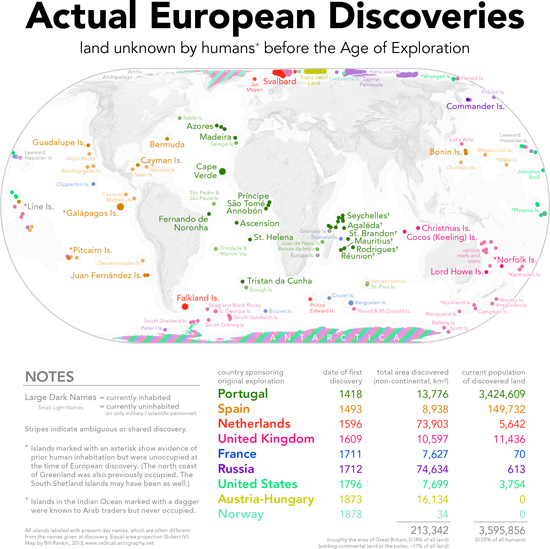
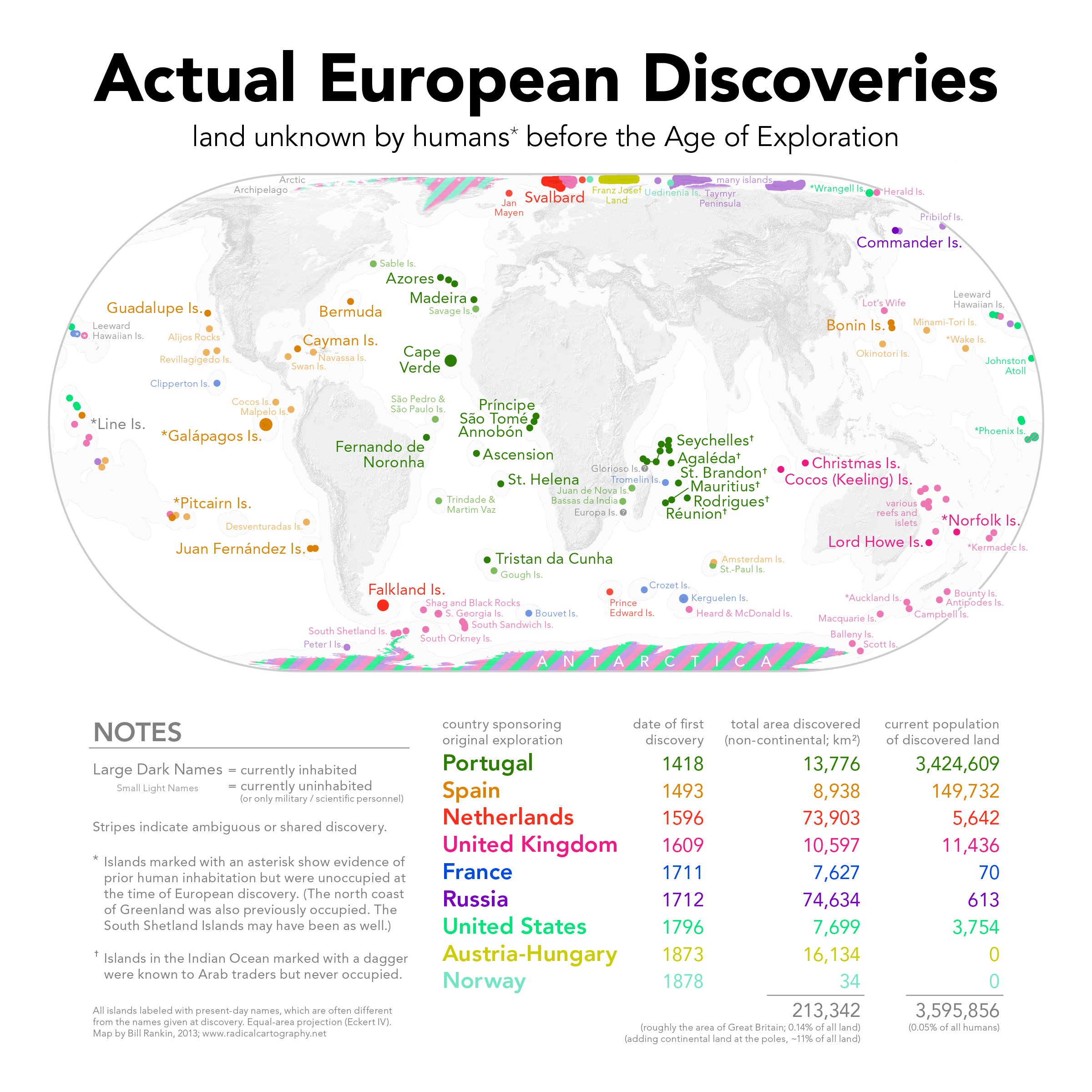
"Islands and ice, mostly," says Bill Rankin of his map Actual European Discoveries.
(Click the link below for a larger version to see detail.)
In the past few decades, there has been a discussion amongst historians, geographers, anthropologists and the like about just what to call what was going on in the “Age of Discovery.”  Was it “discovery”? “exploration”? “encounter”? “invasion”? “reconnaissance”?

The term for the longest time has been discovery.  Older histories (and the general public still) used “Columbus’s discoveries” or “Columbus discovered America” and the like.  But this has been pointed out to be Eurocentric.  Columbus ran across places that other people had already discovered!  They were discovered by the indigenes who lived there!  So scholars, like Brian Harley, used terms such as the “Columbian encounter.”  The word encounter, indeed, has become the popular term used in academe these days, though it has its detractors.  “Encounter” is here to stay alongside “discovery.”  As Marvin Lunenfeld writes in the introduction to 1492—Discovery, Invasion, Encounter: “The neutral word encounter has recently come into general scholarly use.  Encounter seems friendly enough, evoking the idea of social gatherings….  If all that happened in 1492 was that Columbus ‘encountered’ the Amerindians, the historian would successfully escape the ethnocentric connotations of a discovery and the violent implications of an invasion.”

Dr. Bill Rankin, Assistant Professor of History of Science at Yale University, has constructed a map titled Actual European Discoveries for his website Radical Cartography that shows just what little Europeans actually discovered in the sense of no other humans were there to greet them.  As Rankin notes (a tad sarcastically, he admits): “Every Columbus Day, were reminded of the difference between discovery and discovery—and rightly so.  But let's not sell Europe short; after all, European explorers found plenty of diminutive islands that no human had ever seen before, along with extravagant amounts of ice and snow.”

If the Society for the History of Discoveries was holding its fourth annual meeting this year instead of its fifty-fourth, would it be named the “Society for the History of Encounters”?


26 August 2013

Speakers at the Fifty-fourth Annual Meeting of the Society for the History of Discoveries

A depiction of what might be Florida from the 1502 Cantino map.
The following is a list if speakers for the Fifty-fourth Annual Meeting of the Society for the History of Discoveries (SHD), which will be held this year in Tampa, Florida, at the Tampa Bay History Center (TBHC) from October 31–November 3, 2013.

Speakers

ALTIC, Mirela (Croatia): "Missionary Cartography of the Amazon after the Treaty of Madrid (1750): A Jesuit's Contribution to the Demarcation of Imperial Frontiers"

BECK, Lauren: "A Moroccan Ambassador’s Travelogue in Spain (1690-91) and Its Legacy"

BLICK, Jeffrey: "The Case for San Salvador as the Site of the 1492 Columbus Landfall: Principles of Historical Archaeology Applied to Current Evidence"

COWDREY, Peter: "Mapping La Florida"

DELIZ, Michael: "The Digital Reconstruction of El Mapa Militar de Puerto Rico: An Analysis of the Spanish Military Topographic Project in Puerto Rico, 1872-1897"

EDNEY, Matthew: "The Transatlantic Circulation of Geographical Maps before 1763"

GASPAR, Joaquim (Portugal): "The representation of the Western Indies in the early Iberian cartography: a cartometric approach"

MATTHEWS, Jim: "Love Letters and Lesser Beings: Travel Accounts of French and Moroccan Diplomats during the Ancien Régime"

McGUIRK, Don: "Is North America REALLY pictured on the Waldseemüller World Map of 1507?"

MILANICH, Gerald T. (Florida Museum of Natural History): "Early Encounters by European Explorers with Native Americans in Florida"

PFLEDERER, Richard: "Exploring the Manuscript Cartography of Florida and its connection to Exploration and Settlement of the Territory"

SKURNIK, Johanna (Finland): "Circulating exploration knowledge: tracing the discussion of the interior of Australia in the 1840s"

TOUCHTON, J. Thomas & KITE-POWELL, Rodney (Tampa Bay History Center): "Charting the Land of Flowers: 500 Years of Florida Maps" – An introduction to the temporary exhibition at the Tampa Bay History Center

WALKER, Jim: "Alterity and Allegory: Cannibalism, Early Maps and European Conceptions of Amerindian Civility"

Essay Contest Winner

MARCOTTE, Josh: "Culture, Contact and the Agency of Appropriation in a 1741 Map of Nagasaki"

Key Note Speaker

FRANCIS, J. Michael (University of South Florida, St. Petersburg): "Colonial Martyrs: Franciscans, Indians, and the Spiritual Conquest of Florida"

16 August 2013

Society for the History of Discoveries 54th Annual Meeting

Juan Ponce de León, who discovered and named Florida for the Spanish in 1513.
The Fifty-fourth Annual Meeting of the Society for the History of Discoveries (SHD) will be held this year in Tampa, Florida, at the Tampa Bay History Center (TBHC) from October 31–November 3, 2013.

Among the exhibits at this year's TBHC is "Charting the Land of Flowers: 500 Years of Florida Maps," celebrating the 500th anniversary of Florida's naming and discovery by Juan Ponce de León.

20 July 2013

Some Presentations from the "Re-Drawing Ptolemy" Conference

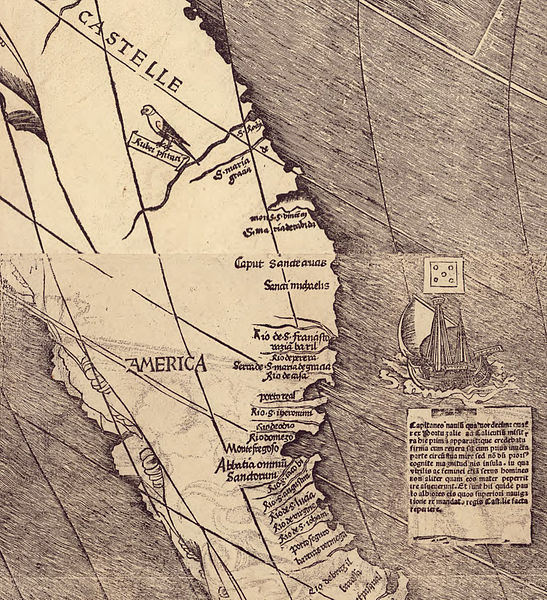
Detail of South America from the Waldseemüller map, Universalis Cosmographia, 1507.
On May 17-18, 2013, the Library of Congress hosted the conference "Re-Drawing Ptolemy: The Cartography of Martin Waldseemüller and Mathias Ringmann,"  sponsored by the Philip Lee Phillips Society, the Library of Congress’s Geography and Map Division, and the John Carter Brown Library.

Television channel C-SPAN3 filmed some the speaker's presentations and posted them online as "Waldseemuller's Map of America."