
13 July 2014
55th Annual Meeting of the Society for the History of Discoveries
Preliminary information of the 55th Annual Meeting of the Society for the History of Discoveries to be held 30 October - 2 November 2014 in Austin, Texas is available at: http://www.sochistdisc.

17 May 2014
The wreck of Columbus's flagship found?
 |
| The anchor of the Santa María now rests in the Musée du Panthéon National Haïtien, in Port-au-Prince, Haiti. |
The ship was wrecked on Christmas Eve, 1492, and sank the next day, after a cabin boy was allowed to steer because all the other sailors were asleep from the festivities of the day. Columbus ordered the deck timbers salvaged to create the first European settlement in the Caribbean, named La Navidad ("Christmas"). Archaeological evidence has located La Navidad nearby.
Clifford believes the remains of the Santa María are lodged on a coral reef about ten to fifteen feet below the water's surface. Photos of the site in 2003 show a lombard canon, which Clifford avers has now been looted from the site. Clifford says that, "All the geographical, underwater topography and archaeological evidence strongly suggests that this wreck is Columbus' famous flagship, the Santa Maria."
Laurence Bergreen, author of Columbus: The Four Voyages, is more skeptical. He wonders how much of the ship would remain, given its age, the influence of earthquakes and hurricanes, and that most of the wood from the ship was used for La Navidad (and want was not used for lumber, he believes, would have rotted away). Bergreen also comments on the lombard canon from 2003 have disappeared: "But now the lombards, if that's what they were, are gone. There's not much left to go on."
Clifford has tried to interest the Haitian government in protecting and excavating the site. He said, "The Haitian government has been extremely helpful–and we now need to continue working with them to carry out a detailed archaeological excavation of the wreck." Bergreen agrees that more investigation is needed: "Given its potential historic significance, let's hope this wreck will finally receive the careful and responsible attention it deserves."
- "Has Wreckage of Christopher Columbus’ Flagship Been Found?" by Barbara Maranzani, History.com
- "Exclusive: Found after 500 years, the wreck of Christopher Columbus’s flagship the Santa Maria," by David Keys, The Independent (UK)
- "Has the ship Columbus discovered the New World in been found? Wreck found off the coast of Haiti believed to be 500 year old Santa Maria" by Mark Prigg, Daily Mail
- "Columbus’ Santa Maria has been already been LOOTED: Diver who claims to have found 500-year-old wreck says ship must be preserved immediately," by Darren Boyle, Daily Mail
- "Is shipwreck really the Santa Maria?" by Laurence Bergreen, CNNOpinion
15 April 2014
Women, exploration and discovery: Special panel/issue to be published in Terrae Incognitae
 |
| Ida Laura Pfeiffer (1797-1858), an Austrian explorer and author. |
Three-hundred-word proposals accompanied by a brief biographical abstract should be received by May 15, 2014, via email to Dr. Lauren Beck (lbeck@mta.ca). Ideally contributors will both present their research and see it published in the journal, but if this is not possible, please email the editor for further information.
11 April 2014
The Hidden World of Women Cartographers
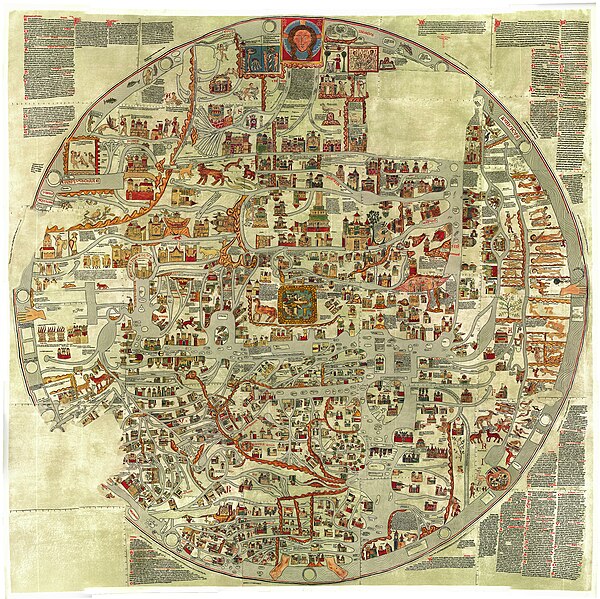 |
| In Map Worlds: A History of Women in Cartography, author Will C. Van Den Hoonaard suggests the thirteenth-century Ebstorf mappa mundi may have been created by the nuns of the Ebstorf abbey. |
21 February 2014
Marginalia in cARTography
 |
| An example of map marginalia, the hard-working Niagara Falls beavers from Herman Moll's A New and Exact Map of the Dominions of the King of Great Britain on ye Continent of America (1715). |
- Marginalia in cARTography
- "Marginalia in cARTography" exhibition catalog by Sandra Sáenz-López Pérez (low-resolution version)
- "Marginalia in cARTography" exhibition catalog by Sandra Sáenz-López Pérez (high-resolution version)
30 January 2014
Terra Incognita to Australia
 |
| Archipelagus Orientalis, sive Asiaticus by Johannes Blaeu (1659) |
Maps range from charts made by Australia's Aborigines, to sea charts, to great world maps showing Australia as blank conjectures. Artifacts include chronometers, bowls from the Dutch East India Company, and mariner’s calipers. Online extras for "Mapping Our World: Terra Incognita to Australia" include YouTube videos, podcasts, checklists, and interactive maps.
Head of maps at the British Library Peter Barber said: "You wouldn't get this exhibition in Europe because the institutions would never lend." The National Library’s curator of maps, Martin Woods, gushed, "I don't know how much more excited I could be!"
- Mapping Our World: Terra Incognita to Australia at the National Library
- Mapping Our World: exhibition highlights
- "Russell Crowe in Canberra to launch National Library of Australia's summer blockbuster," The Sydney Morning Herald, by Natasha Rudra and Sally Pryor
21 January 2014
Does a kangaroo in 400-year-old manuscript prove the Portuguese discovered Australia?
 |
| A kangaroo in a circa 1600 sheet of processional music from Portugal? If so, it could prove the Portuguese were the first Europeans to reach Australia. (Source: Les Enluminures Gallery) |
The manuscript, a sheet of liturgical music, also has a images of half-naked men wearing a chaplet of leaves that could be a depiction of Australian aborigines.
 |
| An Australian aboriginie? (Source: Les Enluminures Gallery) |
Dr. Martin Woods of the National Library of Australia said the kangaroo-like animal could be "another animal in south-east Asia, like any number of deer species." Dr. Peter Pridmore of La Trobe University suggests that the animal depicted could be an aardvark.
Les Enluminures Gallery plans to display the manuscript, with many others from January 24 to February 21, 2014, in an exhibit entitled "Sacred Song: Chanting the Bible in the Middle Ages and Renaissance."
The debate about the possible European discovery of Australia before 1606 continues.
- "Sacred Song: Chanting the Bible in the Middle Ages and Renaissance" at Les Enluminures Gallery
- "16th-century manuscript could rewrite Australian history," The Sydney Morning Herald, by Charli Newton
- "Kangaroo in 400-year-old manuscript could change Australian history," The Telegraph
- "Does tiny kangaroo show Portuguese got to Australia first?," BBC News
- "That’s no kangaroo on the manuscript – so what is it?," The Conversation, by Peter Pridmore
Subscribe to:
Posts (Atom)